KalphaTech
Case study Exsolidus® Alpha Structure determination

Automated crystal structure determination of diamantane-4,9-dicarboxylic acid

From a 15-minute capillary scan and the molecule written as SMILES, Exsolidus Alpha found the unit cell and solved the crystal structure in a few minutes, with no manual steps.

Published · 3-minute read

At a glance

  • ChallengeDetermine the crystal structure of a rigid cage molecule from powder data alone, without growing a single crystal.
  • What we didRan Exsolidus Alpha with just two inputs: the PXRD pattern and the molecular structure as SMILES.
  • ResultStructure solved in P21/c in minutes, confirmed by repeated independent searches; final Rietveld Rwp 8.34%.

The material

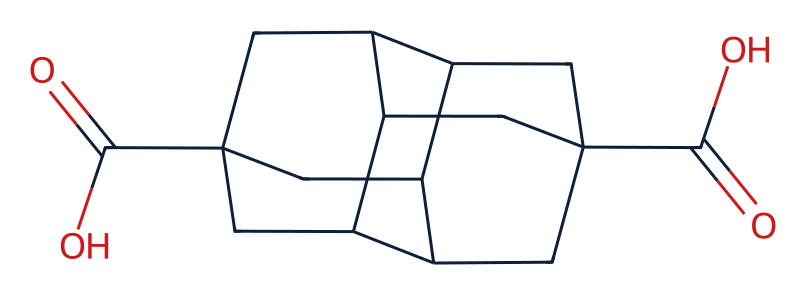
2D structure of diamantane-4,9-dicarboxylic acid: a diamantane cage with a carboxylic acid group at each end
Diamantane-4,9-dicarboxylic acid, C16H20O4

Diamantane-4,9-dicarboxylic acid is a rigid, linear dicarboxylic acid built on a diamantane cage. It serves as a linker in metal–organic frameworks, for example in a UiO-66-type material reported by Gvilava et al. (CrystEngComm, 2022, 24, 7530–7534).

Molecules like this often form fine powders rather than crystals large enough for single-crystal diffraction, so the structure has to come from the powder pattern.

Data and inputs

Measurement
Laboratory PXRD, Cu radiation, 0.5 mm capillary, 2–70° 2θ, 15-minute scan
Inputs
The powder pattern, and the molecule as SMILES
SMILES
C1C2C3CC4(CC2C5CC1(CC3C5C4)C(=O)O)C(=O)O
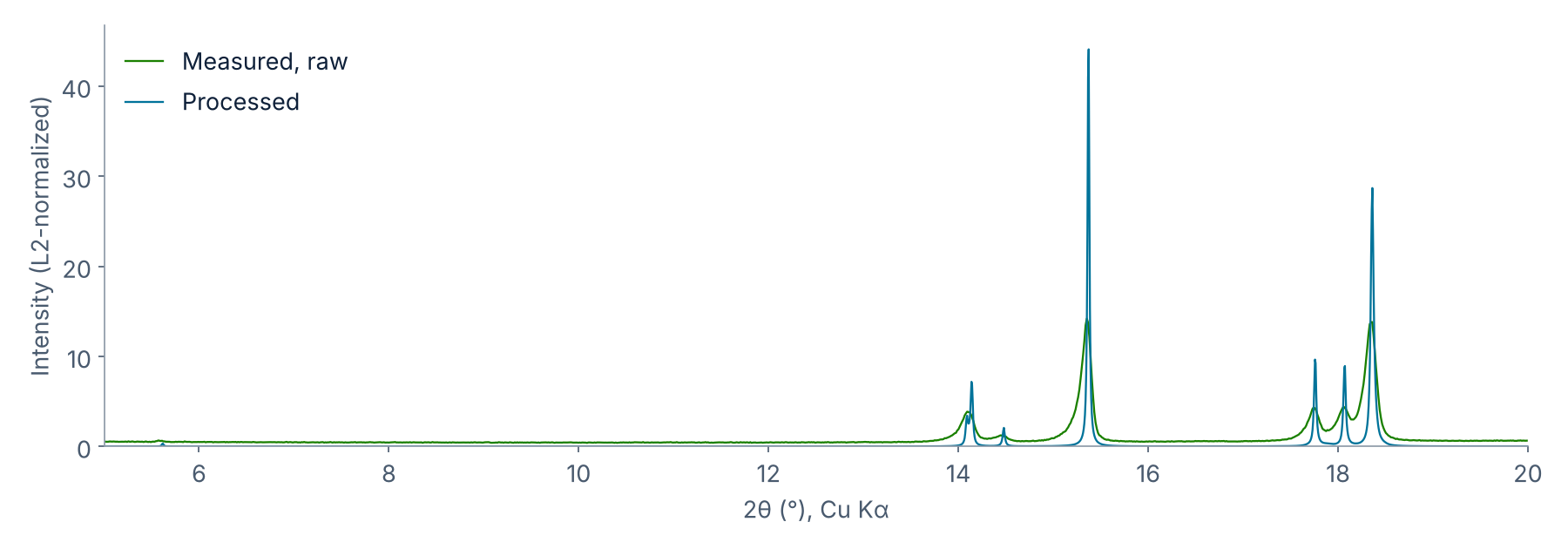
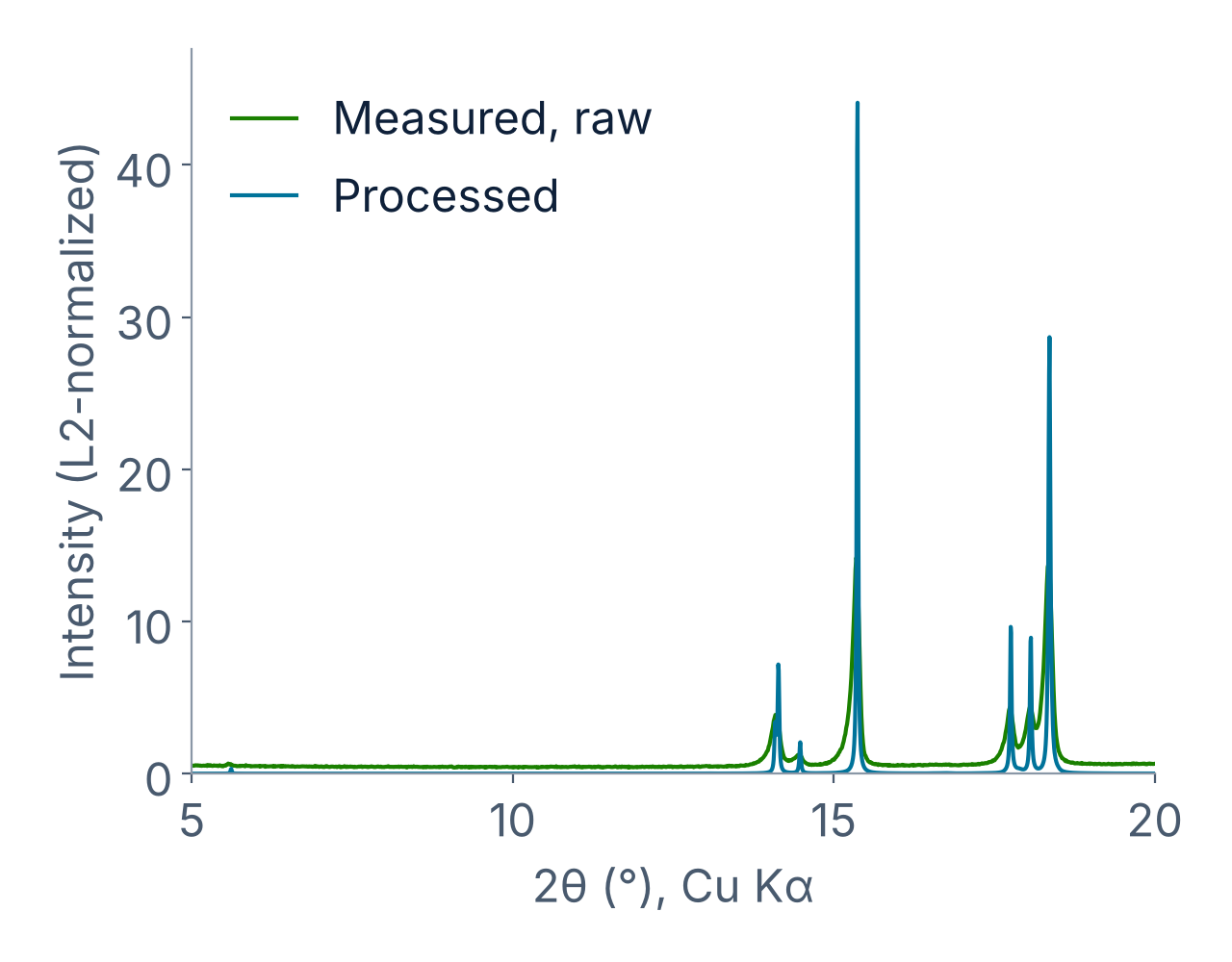
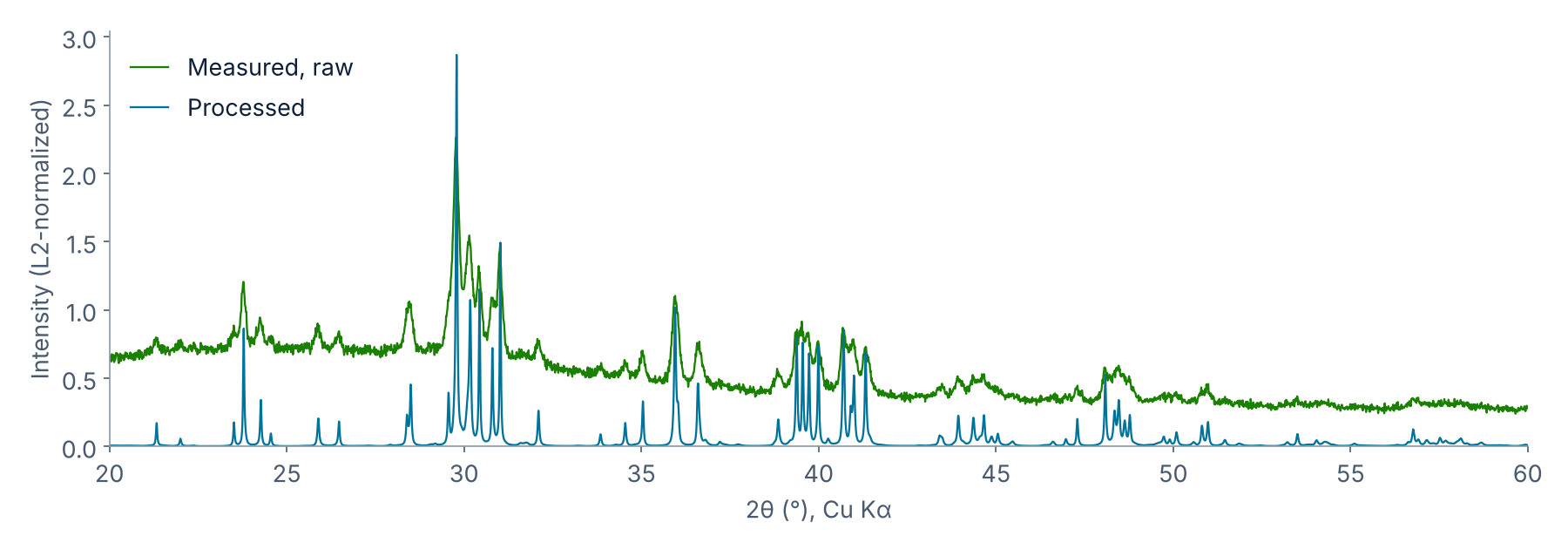
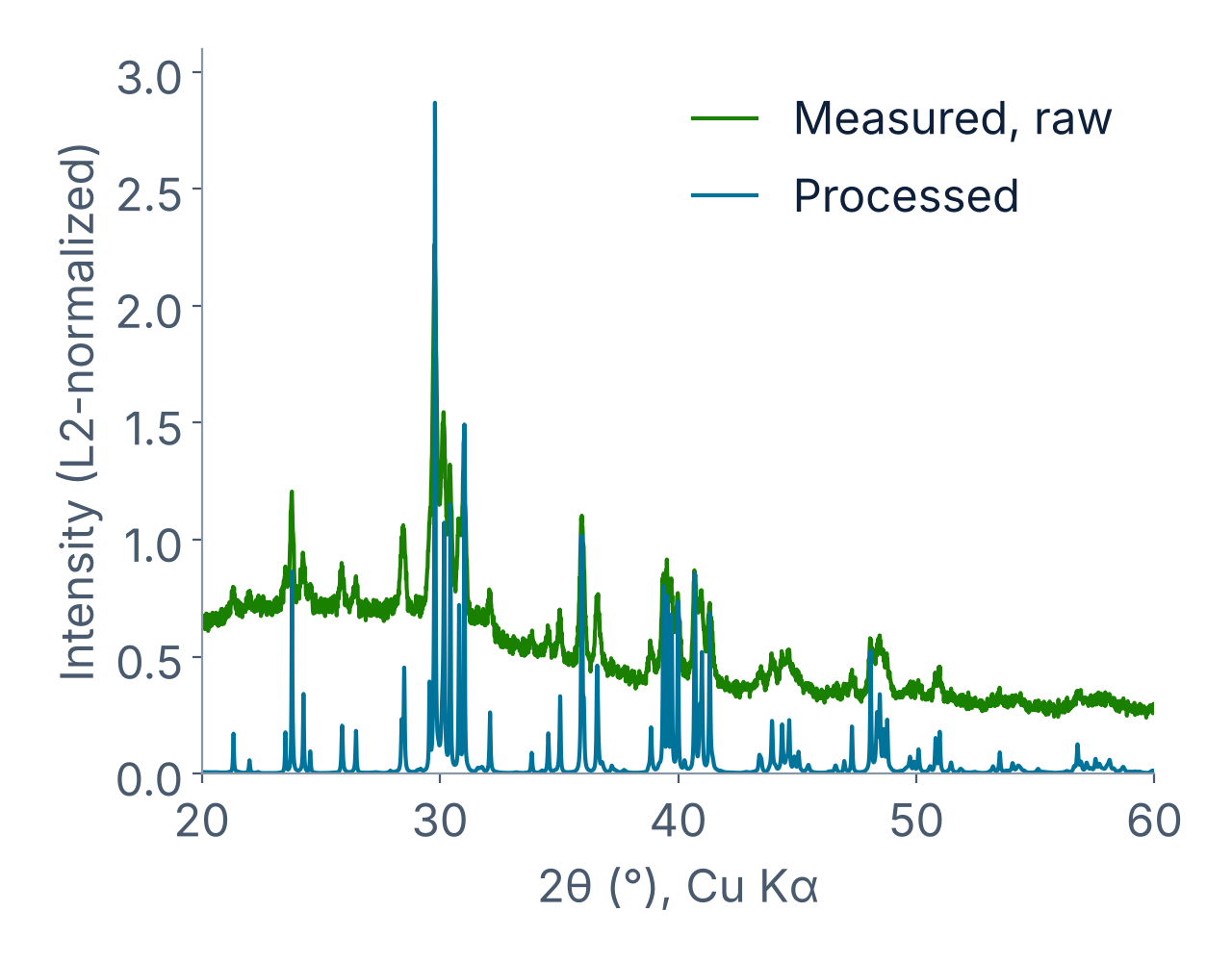
Measured raw and processed powder patterns of diamantane-4,9-dicarboxylic acid from 5 to 20 degrees 2-theta, overlaid on the same scale. The processed peaks are narrower and taller; the strongest peaks are at about 15.4 and 18.4 degrees, with smaller ones near 14.1, 17.8 and 18.1 degrees Measured raw and processed powder patterns of diamantane-4,9-dicarboxylic acid from 5 to 20 degrees 2-theta, overlaid on the same scale. The processed peaks are narrower and taller; the strongest peaks are at about 15.4 and 18.4 degrees, with smaller ones near 14.1, 17.8 and 18.1 degrees Measured raw and processed powder patterns of diamantane-4,9-dicarboxylic acid from 20 to 60 degrees 2-theta, overlaid on the same scale. The raw pattern sits on a sloping background; the processed pattern has no background and resolves its broad bumps into many sharp peaks, the strongest near 29.8 degrees Measured raw and processed powder patterns of diamantane-4,9-dicarboxylic acid from 20 to 60 degrees 2-theta, overlaid on the same scale. The raw pattern sits on a sloping background; the processed pattern has no background and resolves its broad bumps into many sharp peaks, the strongest near 29.8 degrees
Figure 1. Measured powder pattern of diamantane-4,9-dicarboxylic acid, raw (green) and after processing (blue), shown from 5 to 20° and from 20 to 60° 2θ. Both are L2-normalized and shown on the same scale.

An automated solution

Exsolidus Alpha ran the whole workflow on its own. The unit cell and the crystal structure were found in a short search of a few minutes.

  1. Index the pattern. The unit cell is found directly from the peak positions.
  2. Fix the cell. A Pawley fit refines the cell and the peak shapes.
  3. Search for the structure. The molecule, built from the SMILES with an ensemble of conformers, is placed in the cell and optimized against the pattern.
  4. Confirm and report. Repeated independent searches converge on the same solution, which is checked with a Rietveld fit and a chemical soundness test, then reported as a CIF ready to download.
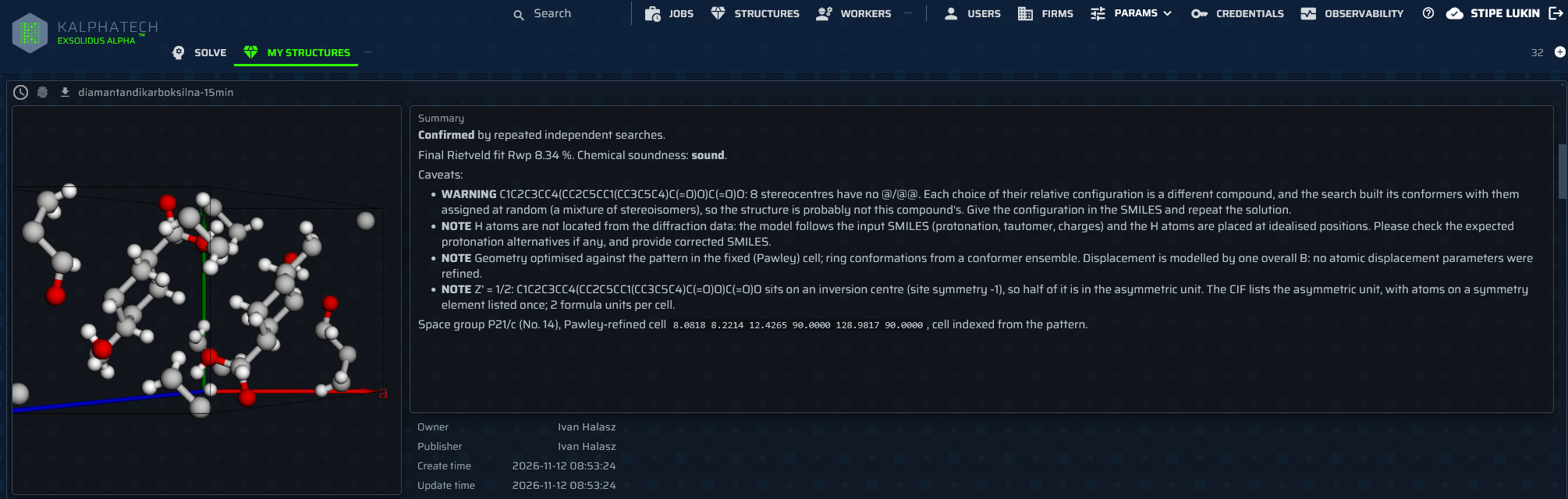
Exsolidus Alpha result page for diamantane-4,9-dicarboxylic acid: the solved structure in 3D next to a summary confirming the solution, the Rietveld fit and the space group
Figure 2. The solution in Exsolidus® Alpha: the structure in 3D, with a summary of the fit, the space group and the cell.

Results

Crystallographic data
Chemical formulaC16H20O4
Space groupP21/c (No. 14), monoclinic
a, b, c8.0818 Å, 8.2215 Å, 12.4266 Å
α, β, γ90°, 128.982°, 90°
Cell volume641.8 Å3
Z, Z′2, ½ (molecule on an inversion center)
Final Rietveld fitRwp = 8.34%

The molecule sits on an inversion center in space group P21/c, so half of it forms the asymmetric unit. Neighboring molecules pair through their carboxylic acid groups, forming hydrogen-bonded carboxylic acid dimers.
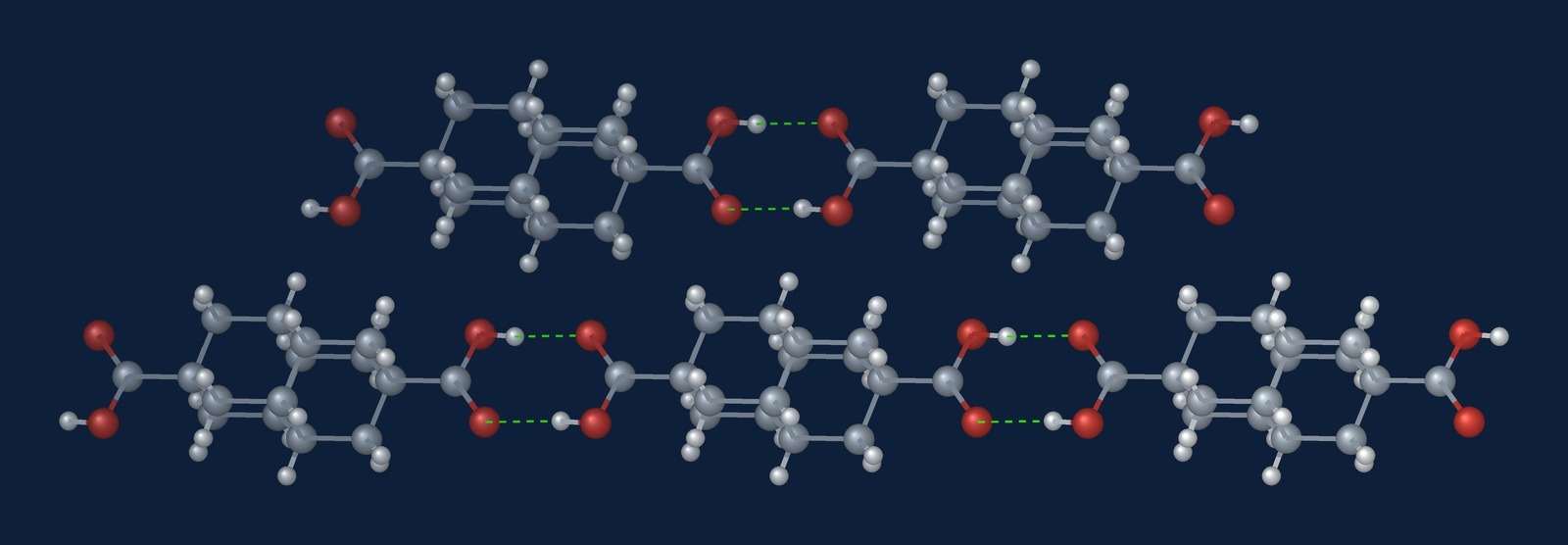
3D view of the solved crystal structure: two parallel chains of diamantane-4,9-dicarboxylic acid molecules, joined end to end by pairs of hydrogen bonds between carboxylic acid groups
Figure 3. The determined structure: molecules link end to end through carboxylic acid dimers (hydrogen bonds as green dashed lines).

What it means for your lab

Two inputs and a short laboratory scan were enough. No single crystal, no synchrotron time and no expert hours spent on indexing and structure search. The result arrives as a CIF, ready for your reports, databases or the next step of your workflow.

Have a powder pattern to solve?

Send us a pattern and the molecule, and we will show you what Exsolidus Alpha finds.

More case studies

All resources