
The challenge
The API should contain one crystal form. A second, unwanted form can appear during crystallization, and even a small amount raises hard questions. Is it really there? How much is there? Is there still time to act?
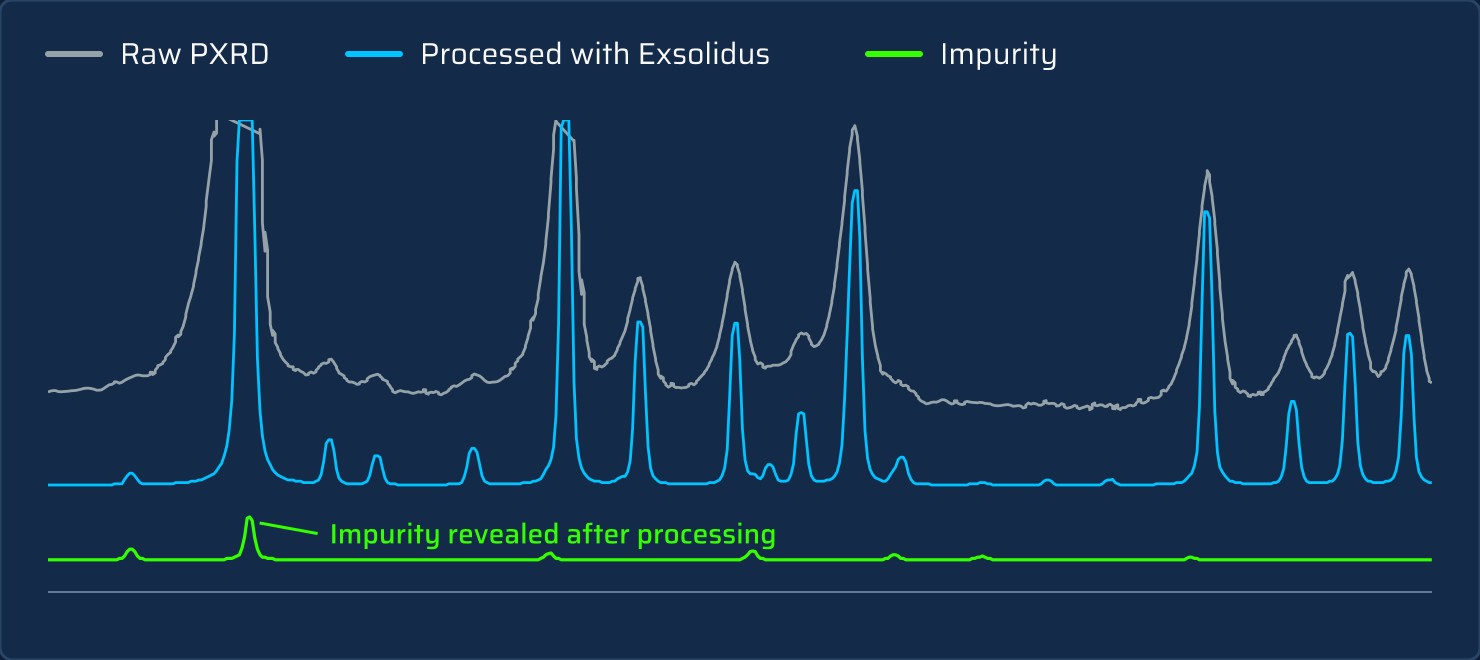
In laboratory PXRD, the two forms overlap heavily. The minor form’s peaks sit in the shoulders of the main pattern, so the raw measurement alone leaves the answer uncertain.
Data and conditions
- Material
- Antibiotic API, anonymized: the desired form with a suspected minor second form
- Instrument
- Laboratory powder diffractometer
- Analysis
- Exsolidus Detect processing workflow.
Our approach
We ran the measured pattern through Exsolidus Detect. It removes the instrument and sample effects that broaden peaks, so features that overlapped in the raw data separate.
Phase analysis of the processed pattern then modeled the desired form and the suspected second form side by side.
Results
After processing, the second form no longer disappears into the shoulders of the main peaks. The analysis supported its identification and gave an estimate of its share of the sample.
An ambiguous pattern became a clear next step: investigate the unwanted form, compare batches from different crystallization conditions, or build a method to monitor it.
What it means for production
Run on samples taken during crystallization, the same approach can flag an unwanted form while the process can still be adjusted, rather than at release testing. That lowers the risk of an out-of-specification batch, on the diffractometer you already have.
For R&D, it shows how crystallization conditions shift solid-form composition. For QC, it is the starting point for a PXRD method built around the forms and reporting levels that matter for your API.
Discuss a PXRD method for your API
Bring a challenging dataset and the decision your team needs to make. We will show you what Exsolidus Detect can do with it, for crystallization development or a QC method.
Discuss your PXRD challenge